FlorentinoAudio Lab
Español Cart

How our plug-ins work

What happens inside each Florentino Audio Lab plug-in, in plain words: the signal path, the character, and what every design choice is for.

VOCAL

IronVox

IronVox

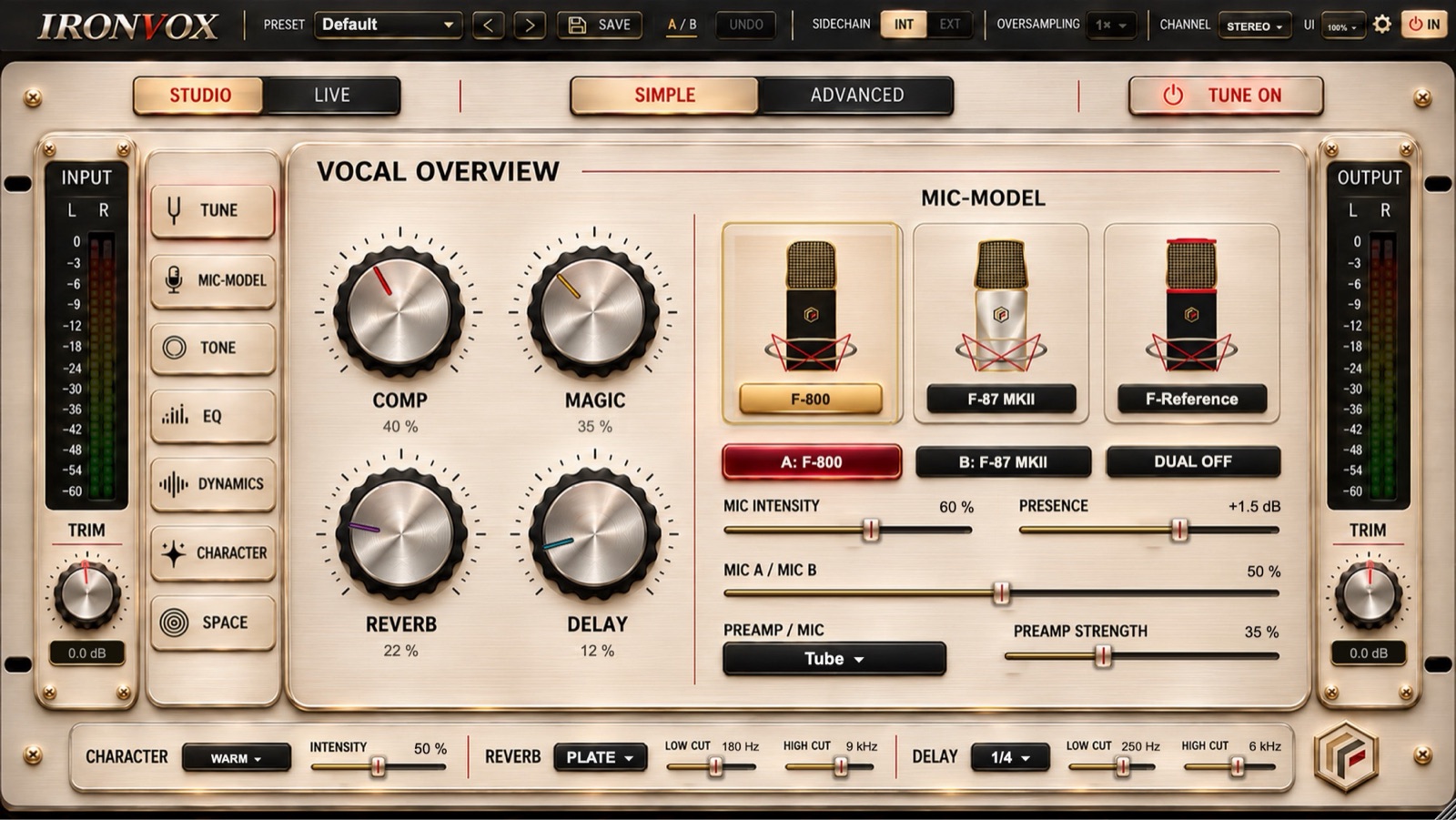
IronVox is a whole vocal chain in one window: pitch correction, three microphone voicings with a preamp, a six-band dynamic EQ, three compressors, character and space. The SIMPLE page puts the moves that matter on four knobs; ADVANCED opens every module when you want to go deep.

The voice runs through the modules in a fixed, studio-proven order: INPUT, TUNE, MIC-MODEL, EQ, TONE, DYNAMICS, CHARACTER, SPACE, OUTPUT. Cleaning and shaping happen before compression, colour and space after it, so each stage gets the signal it expects.

TUNE follows the pitch of the voice and pulls each note to the key you set; KEY LISTEN listens for a few seconds and finds the key for you. MIC-MODEL gives the voice the frequency signature of three original microphone voicings (a bright tube condenser, a classic large condenser and a flat reference), with a tube or solid-state preamp that runs oversampled, so its harmonics stay clean.

DYNAMICS offers three compressors in the tradition of classic hardware: FET (fast and bold), OPTICAL (slow and smooth) and MULTIBAND (three bands, so a loud low note does not squash the top). A de-esser is built in. CHARACTER adds warmth, brightness or saturation; SPACE adds a plate, room or large reverb and a delay locked to your tempo.
Controls and a sound sample →

CHANNEL & EQ

F-Lapis Channel

F-Lapis Channel

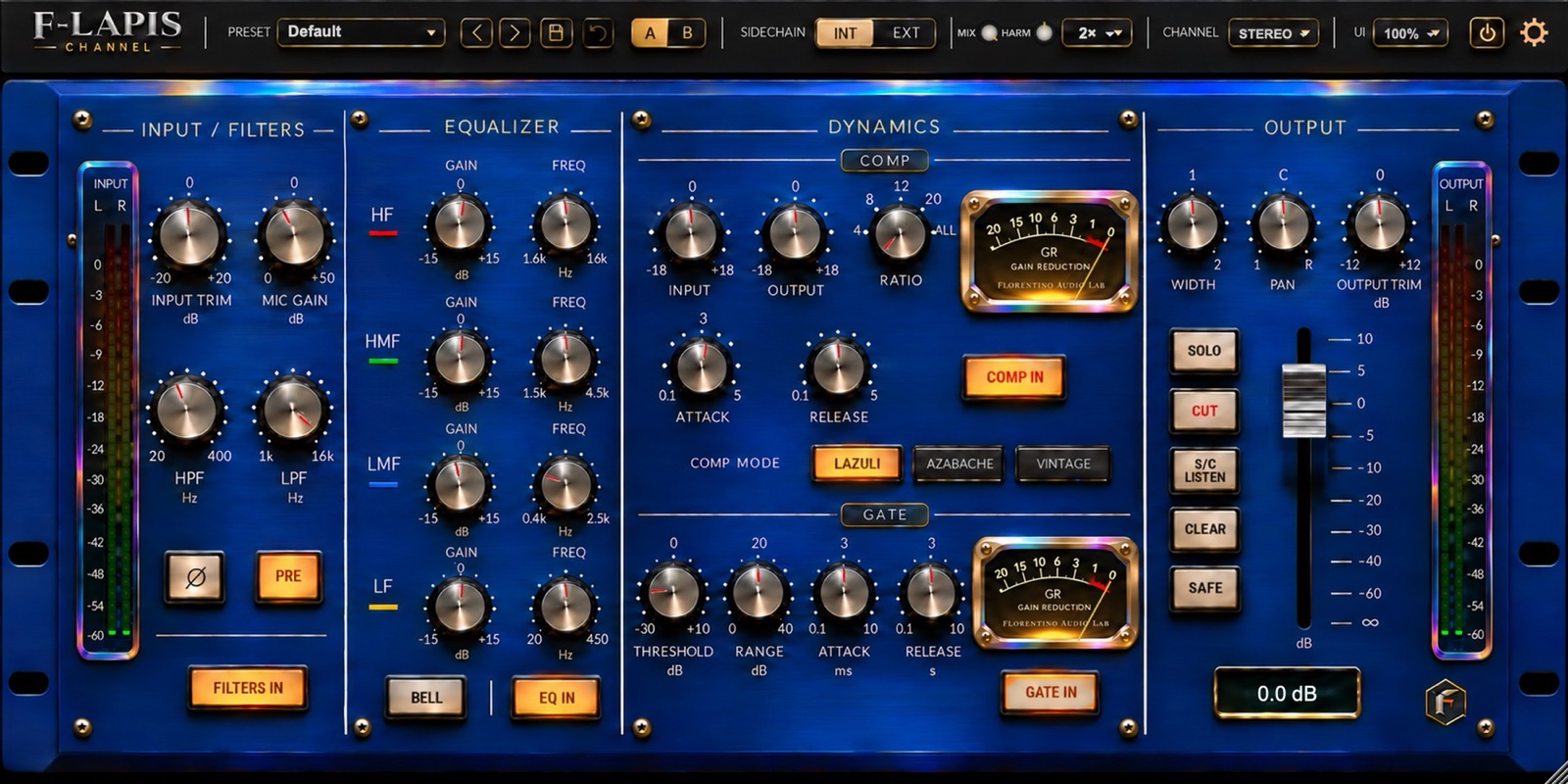
F-Lapis Channel is a full console channel strip: preamp, filters, gate, four-band EQ and a compressor with three characters, in the order a large-format console uses. Put it on every track and mix the way engineers have for decades.

The signal flows INPUT TRIM, polarity, PREAMP, FILTERS, GATE, EQ, COMPRESSOR, then a console line amp, WIDTH, PAN and the FADER. MIC GAIN drives a transformer-coupled preamp stage; its level is compensated, so turning it up adds colour and density, not loudness.

The EQ has a low shelf, two bells whose width tightens as you boost (proportional Q, the way classic console EQs behave) and a high band that works as a shelf or, with HF BELL, as a bell. The filters are matched to their analog response all the way to the top of the spectrum.

The compressor has three characters: LAZULI is clean, fast and firm; AZABACHE is punchy and program dependent and adds harmonics; VINTAGE is slow with a soft knee and a warm tone. Ratios run 4, 8, 12 and 20 to 1, and ALL engages every ratio at once for that famously aggressive, slightly gritty sound. The preamp and the line amp run oversampled.

Controls and a sound sample →

F-FlexCurve

F-FlexCurve

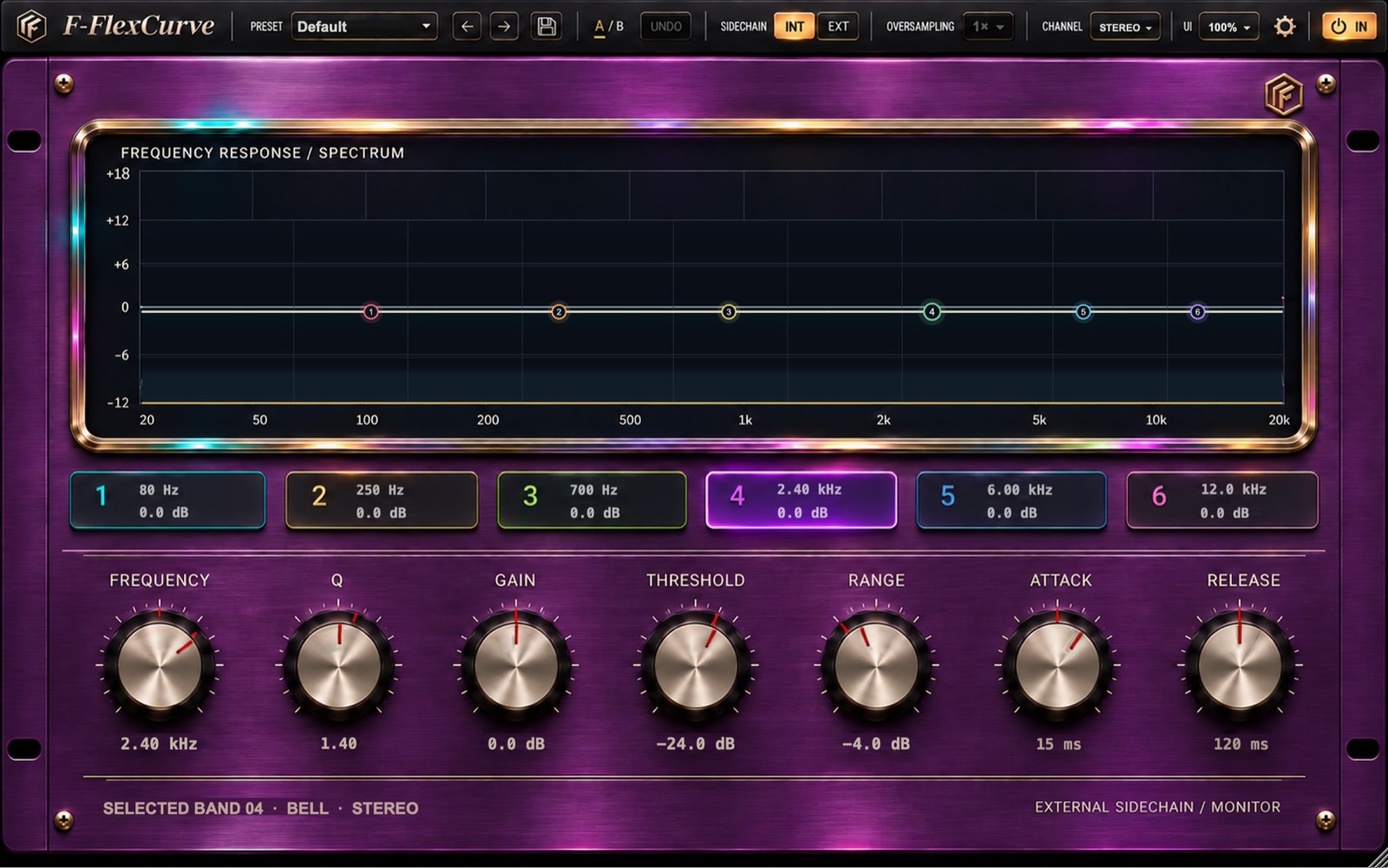
F-FlexCurve is an eight-band dynamic equaliser with a twist: every band can treat the transients and the sustained tone of a sound separately. Fix harshness only when it appears, add snap without adding ring, and carve room for the vocal automatically with Vox Carve.

Each band is a precise filter (bells, shelves and cuts up to 48 dB per octave, matched to the analog response all the way to the top of the spectrum) that can also move with the music: above its threshold it cuts or boosts by up to its range, with its own attack and release, or AUTO timing.

The transient / tonal splitter separates the attack of each sound from its body. A split band then has two gains: one for the attack and one for the tone, so you can brighten the pick of a guitar without brightening its sustain. When nothing is split the two layers add back to exactly one equaliser.

Vox Carve listens to a vocal on the sidechain and dips the music where the voice lives, only while it is singing. The graph shows the live spectrum before and after, every band, and the masking between this track and another F-FlexCurve.

Controls and a sound sample →

ROJO EQ

ROJO EQ

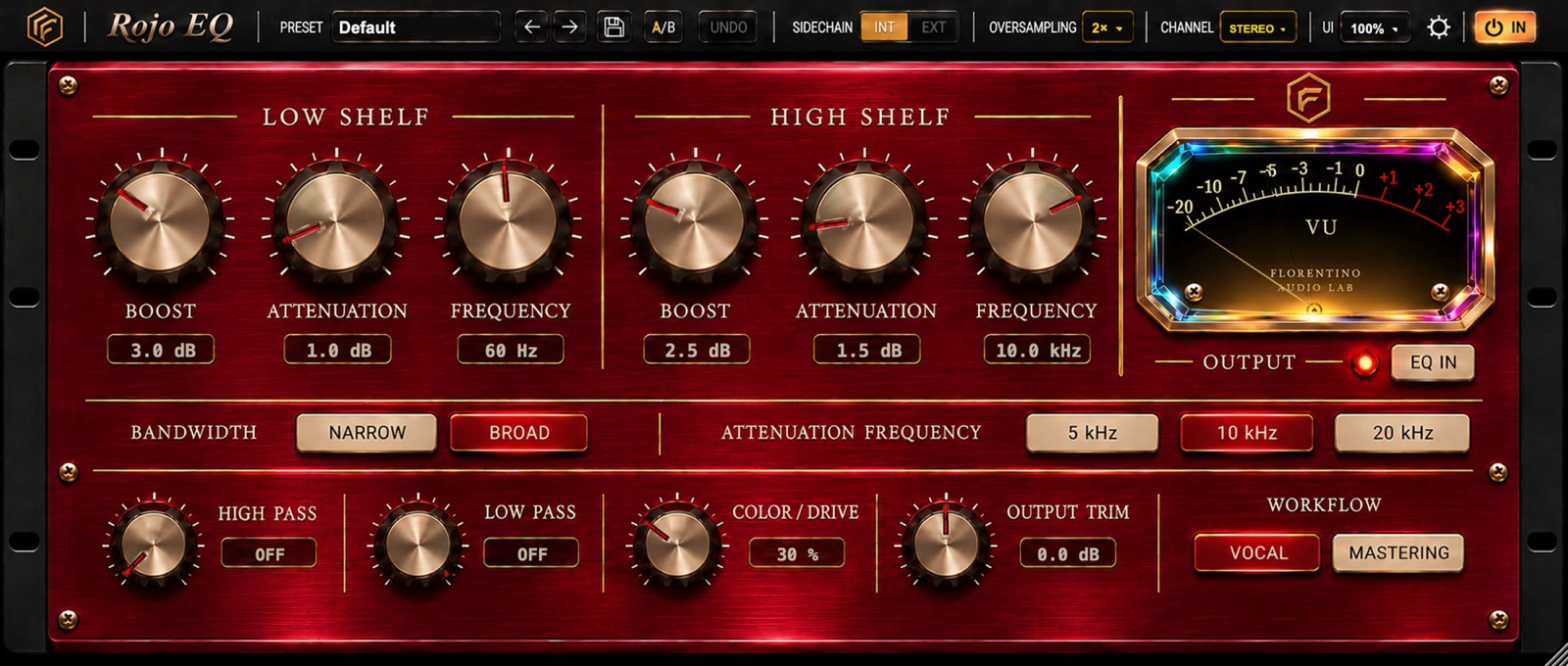
ROJO EQ is a passive program equaliser in the tradition of the 1950s studio classics: broad, musical curves that are hard to make sound bad, and a tube make-up amplifier that adds glow. Boost and cut the same frequency for the famous firm-but-clean low end.

Like the passive equalisers it is inspired by, each band has a separate BOOST and ATTENUATION. On the low band the boost is a broad shelf and the cut a gentler shelf just above it, so turning up both gives a deep, solid bottom with a slight dip above it, the trick engineers have used on kick drums and mixes for decades.

The high band boosts with a bell you can make NARROW or BROAD, and cuts with a shelf at 5, 10 or 20 kHz. High-pass and low-pass filters frame the result. Every curve is matched to its analog shape up to the top of the spectrum.

COLOR / DRIVE feeds the make-up stage: tube warmth and a touch of iron in the lows, oversampled so the added harmonics stay clean. MASTERING mode halves the gain ranges for fine moves and softens the colour.

Controls and a sound sample →

DYNAMICS

F-QuadraDynamics

F-QuadraDynamics

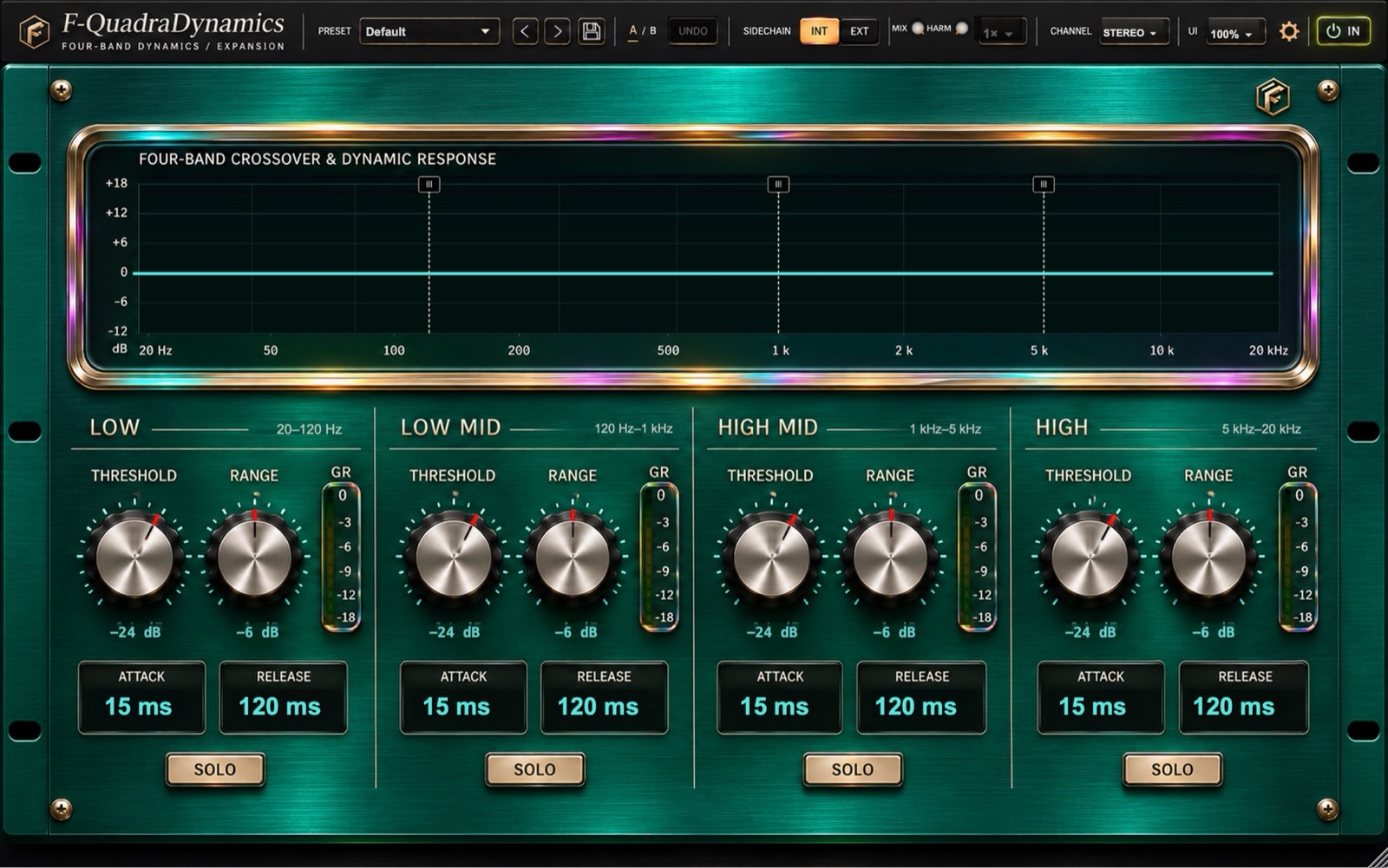
F-QuadraDynamics splits the sound into four bands and gives each its own compressor or upward expander. Control a boomy low end without dulling the top, bring up detail that hides, and glue a mix one frequency range at a time.

Three crossovers you drag on the graph split the signal into LOW, LOW MID, HIGH MID and HIGH. The crossovers are phase-compensated Linkwitz-Riley filters: with every band at rest the four bands add back to exactly the input (measured flat to 0.000 dB).

Each band has one RANGE knob that does two jobs. Turned negative, the band compresses: above its threshold it is turned down by at most that amount. Turned positive, it expands upward: above the threshold it is lifted by at most that amount, which brings out detail and attack. Below the threshold nothing changes.

AUTO GAIN keeps the overall level steady while you work, so you judge tone, not loudness. EXT drives the detectors from a sidechain, split by the same crossovers.

Controls and a sound sample →

F-Kiln Tube Compressor

F-Kiln Tube Compressor

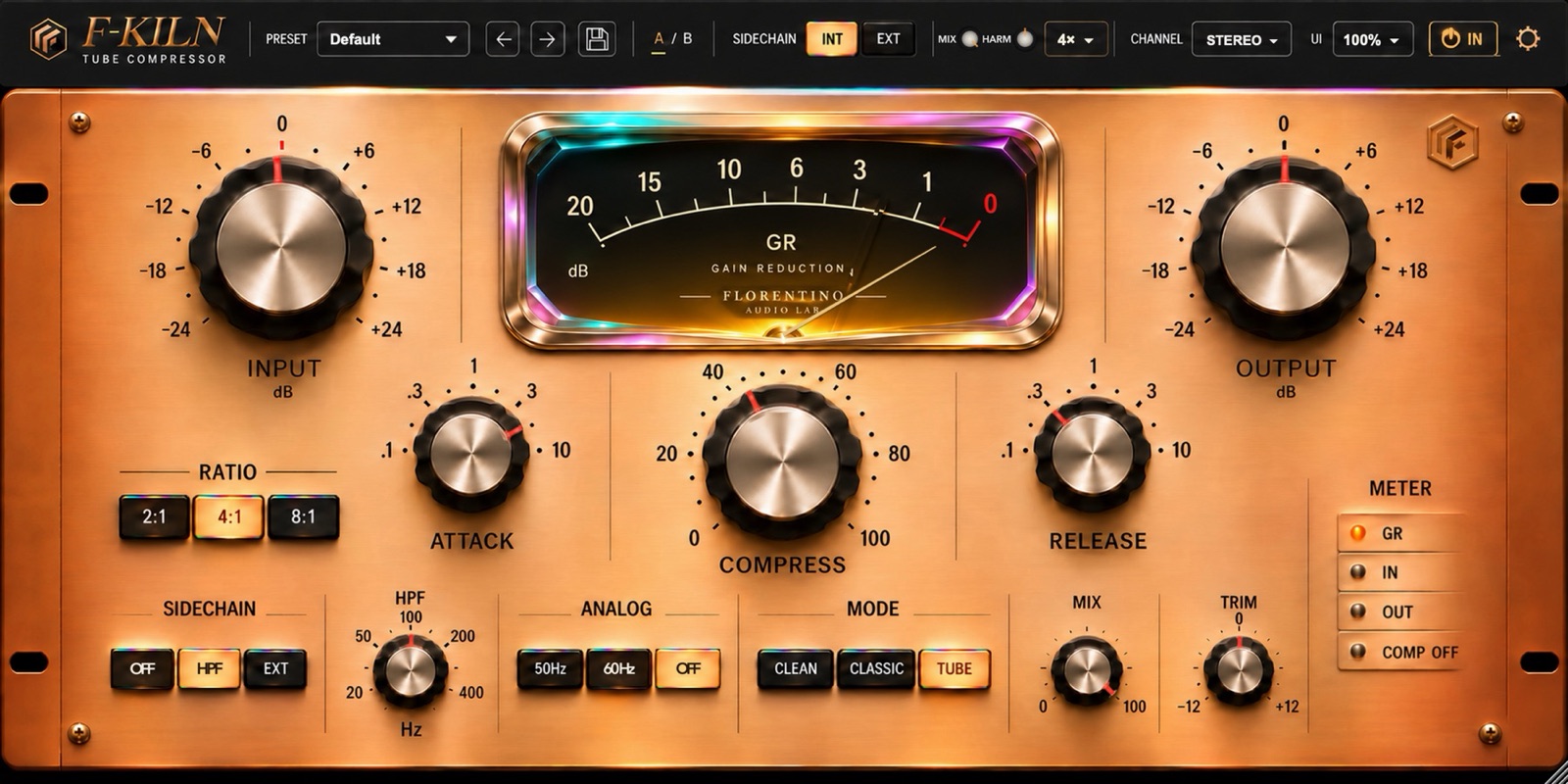
F-Kiln is a tube compressor inspired by the way classic tube levelling amplifiers behave: it holds a vocal or a bus steady while adding the glow and thickness of valves. Three characters take it from clean control to dense, warm glue.

An RMS detector listens to the signal (or to its sidechain, with an optional high-pass so the low end does not pump the compressor) and drives a gain cell. COMPRESS sets how hard it works; the ratio, attack and release shape how it holds the sound.

The three MODES are three different gain cells, not one with a label: CLEAN is a transparent soft-knee cell; CLASSIC is a variable-ratio tube cell with a light triode colour and a release that follows the program; TUBE is the same cell driven harder, warmer and thicker. Measured, their attack and release and their curves really differ (7, 10 and 14 ms of attack at the same setting).

The colour stages run oversampled, so the harmonics stay clean even on bright material. AUTO GAIN makes up what the compression takes, and MIX blends in the dry signal for parallel compression.

Controls and a sound sample →

F-DualLift

F-DualLift

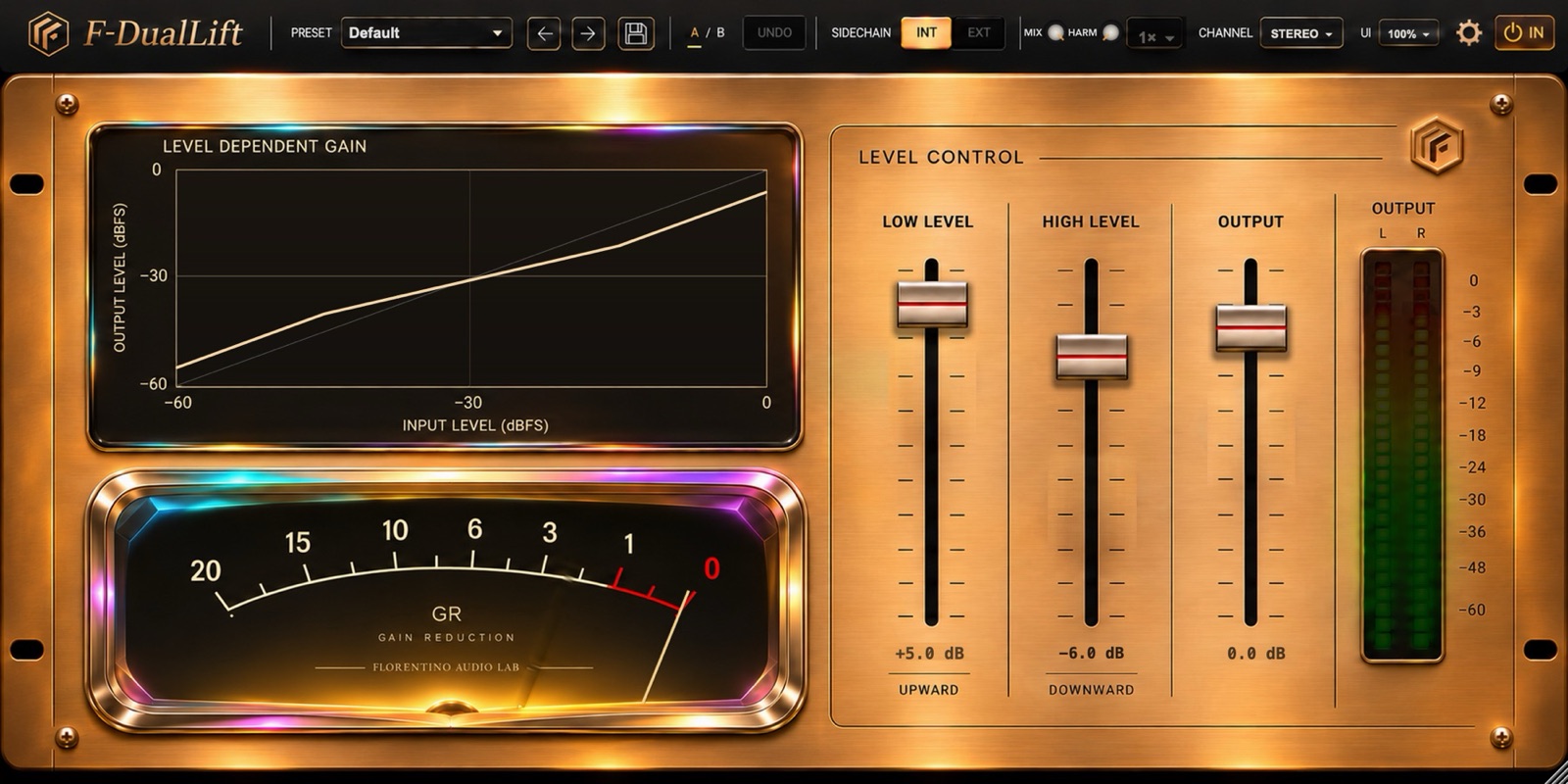
F-DualLift is dynamics in two faders: LOW LEVEL lifts what is quiet, HIGH LEVEL tames what is loud. Even out a performance, bring up breaths and room, or flatten peaks, without learning thresholds and ratios.

A fast RMS detector measures the level of the music. Quiet passages (around −45 dBFS and below) get the LOW LEVEL gain; loud ones (around −15 dBFS and above) get the HIGH LEVEL gain; everything in between moves smoothly from one to the other. The graph draws the resulting curve as you move the faders.

Upward compression needs care so it never lifts the noise: below −60 dBFS the lift fades back to zero, so silence stays silent. AUTO GAIN keeps the level at −20 dBFS where it was, and the whole thing adds no latency.

Controls and a sound sample →

IronClipper

IronClipper

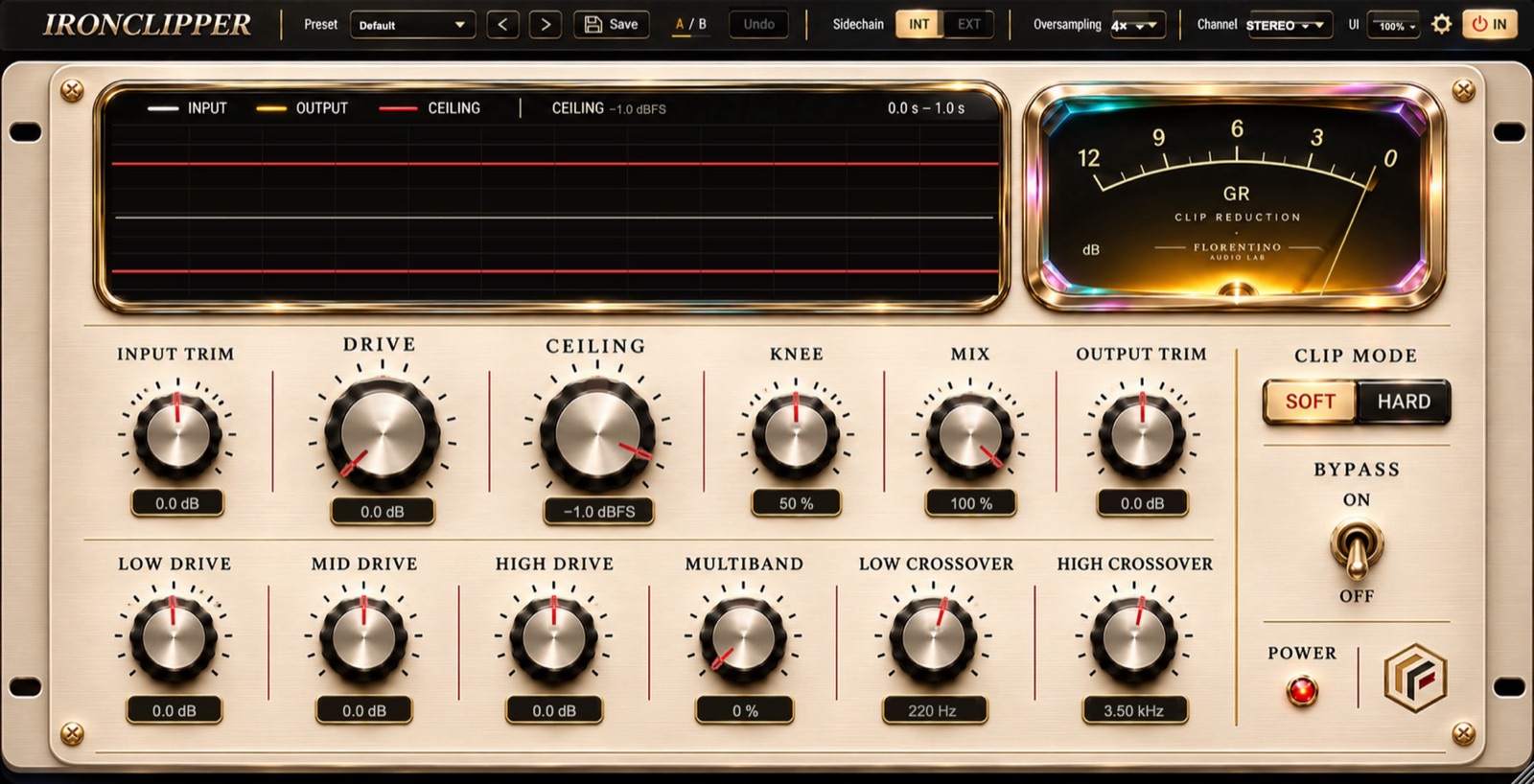
IronClipper shaves peaks off so your track gets louder and punchier without the pumping of a limiter. Soft or hard, single band or multiband, with a ceiling the output never crosses.

A clipper does not turn the whole sound down when a peak arrives; it rounds off only the tip of the peak. That keeps drums snappy and mixes loud. IronClipper passes the signal untouched up to the edge of its knee, then bends it smoothly into the CEILING: SOFT starts the bend early and wide, HARD late and short.

Clipping creates harmonics, and on a computer those can fold back as harsh, unrelated tones. IronClipper runs oversampled (2, 4 or 8x) with antiderivative anti-aliasing on top, then a final 0.7 ms look-ahead guard keeps every output sample under the ceiling.

MULTIBAND blends in a three-band clip (LOW, MID, HIGH, each with its own drive), so you can hold the bass steady while the top is clipped harder.

Controls and a sound sample →

COLOR & SATURATION

F-Ignis

F-Ignis

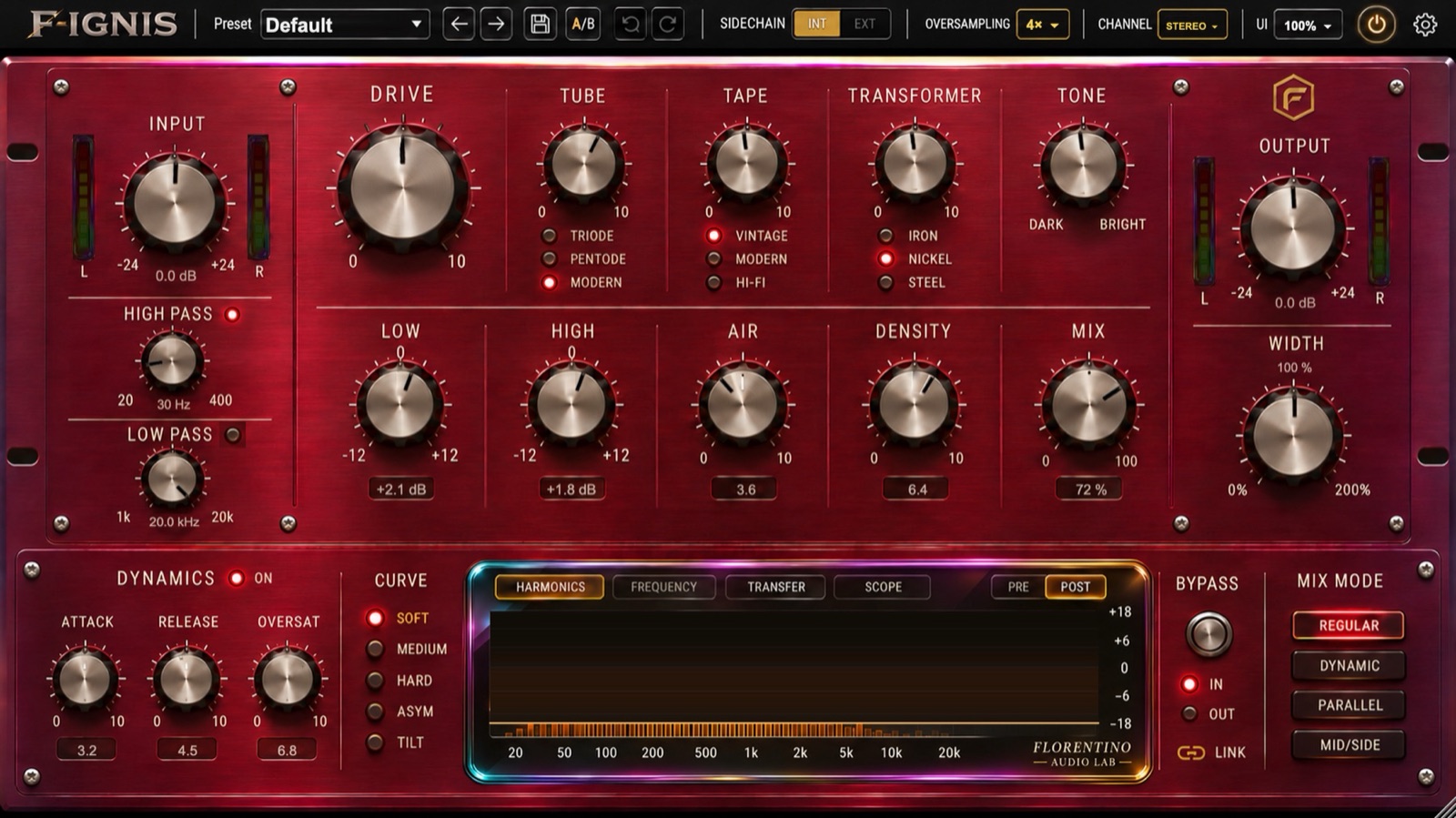
F-Ignis is three classic kinds of analog saturation in one box: tube, tape and transformer, each with three flavours. Add warmth, weight and density to anything, from a gentle glow to a burning drive.

The wet signal runs oversampled through a chain that mirrors a real analog path: DRIVE through the curve you choose, then TUBE, TAPE and TRANSFORMER stages, then tone shaping. Each stage has unity gain for small signals, so turning it up adds harmonics, not volume.

The three families behave differently, as their hardware does. TUBE: TRIODE gives warm even harmonics, PENTODE is brighter and more odd, MODERN stays clean until pushed. TAPE: saturation with head bump and a softer top, VINTAGE, MODERN or HI-FI. TRANSFORMER: saturation that grows in the lows, IRON, NICKEL or STEEL.

DYNAMICS drives the loud moments harder (OVERSAT) with its own attack and release, so the colour breathes with the music. MIX MODE blends REGULAR, DYNAMIC, PARALLEL or MID/SIDE (only the centre saturated), and the analyser shows harmonics, frequency response, the transfer curve or the scope.

Controls and a sound sample →

F-Prism

F-Prism

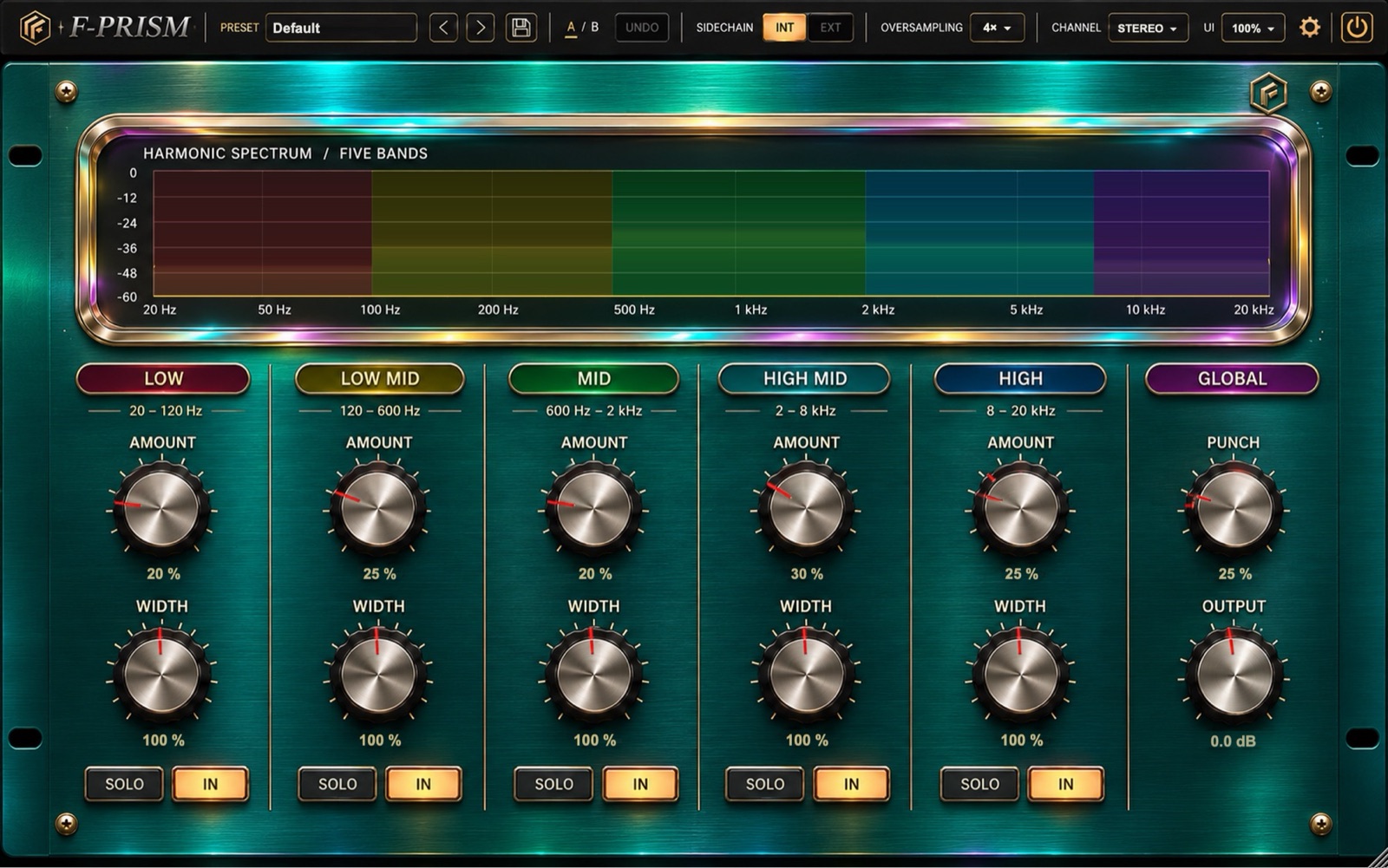
F-Prism adds harmonics in five separate bands, so you can thicken the lows, add presence to the mids and sparkle to the top independently. It makes sounds richer and more audible without EQ boosts and without touching the original signal.

Each band (LOW below 120 Hz, LOW MID to 500 Hz, MID to 2 kHz, HIGH MID to 6 kHz and HIGH above) generates its own second and third harmonics, the overtones the ear hears as warmth and richness. AMOUNT sets how much of that band's harmonics is added; the dry signal itself is never split or filtered.

WIDTH places the new harmonics anywhere from mono to wide, with the mono sum unchanged. PUNCH lets the low bands' harmonics follow the attacks, so kicks and bass notes get more definition. The upper bands generate oversampled, so there is no aliasing.

Controls and a sound sample →

TAPE

F-ReelFour

F-ReelFour

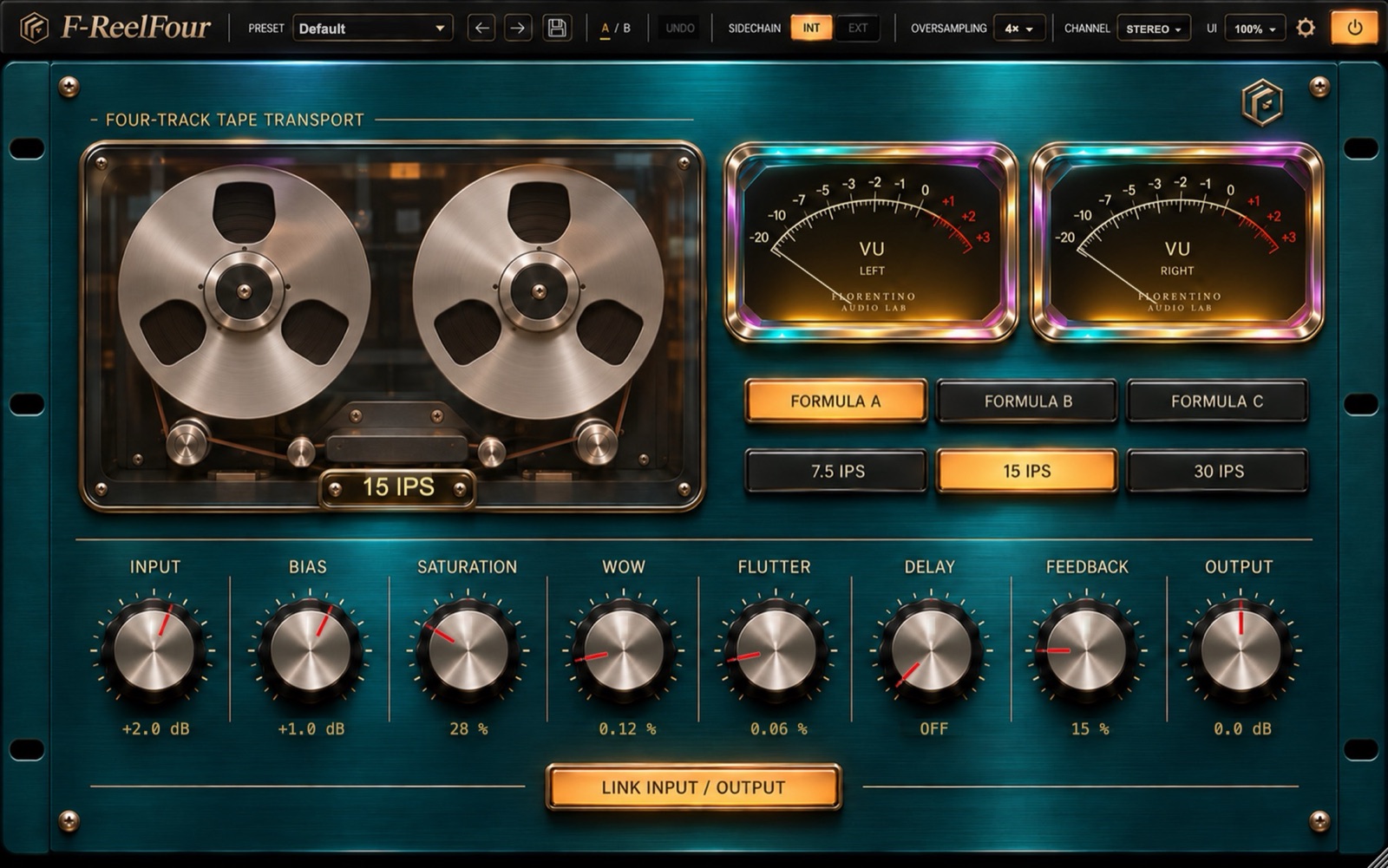
F-ReelFour brings the sound of a four-track tape machine to any track: warm saturation, a rounded top, a little low-end bump and the gentle movement of a real transport. Three tape formulas and three speeds let you go from subtle to proudly lo-fi.

Inside, the signal does what it does on a tape machine: it is emphasised on the way in, recorded through the tape's saturation curve (oversampled), de-emphasised on the way out, and shaped by the head bump and the high-frequency loss that depend on the tape SPEED. BIAS tilts the tape between brighter and cleaner-but-darker, as on a real recorder.

WOW and FLUTTER are the slow and fast speed variations of a transport; DELAY and FEEDBACK turn the machine into a tape echo, each repeat darker and softer than the one before. With LINK INPUT / OUTPUT the output follows the input inversely, so driving the tape changes the colour, not the loudness.

Controls and a sound sample →

F-ReelCraft

F-ReelCraft

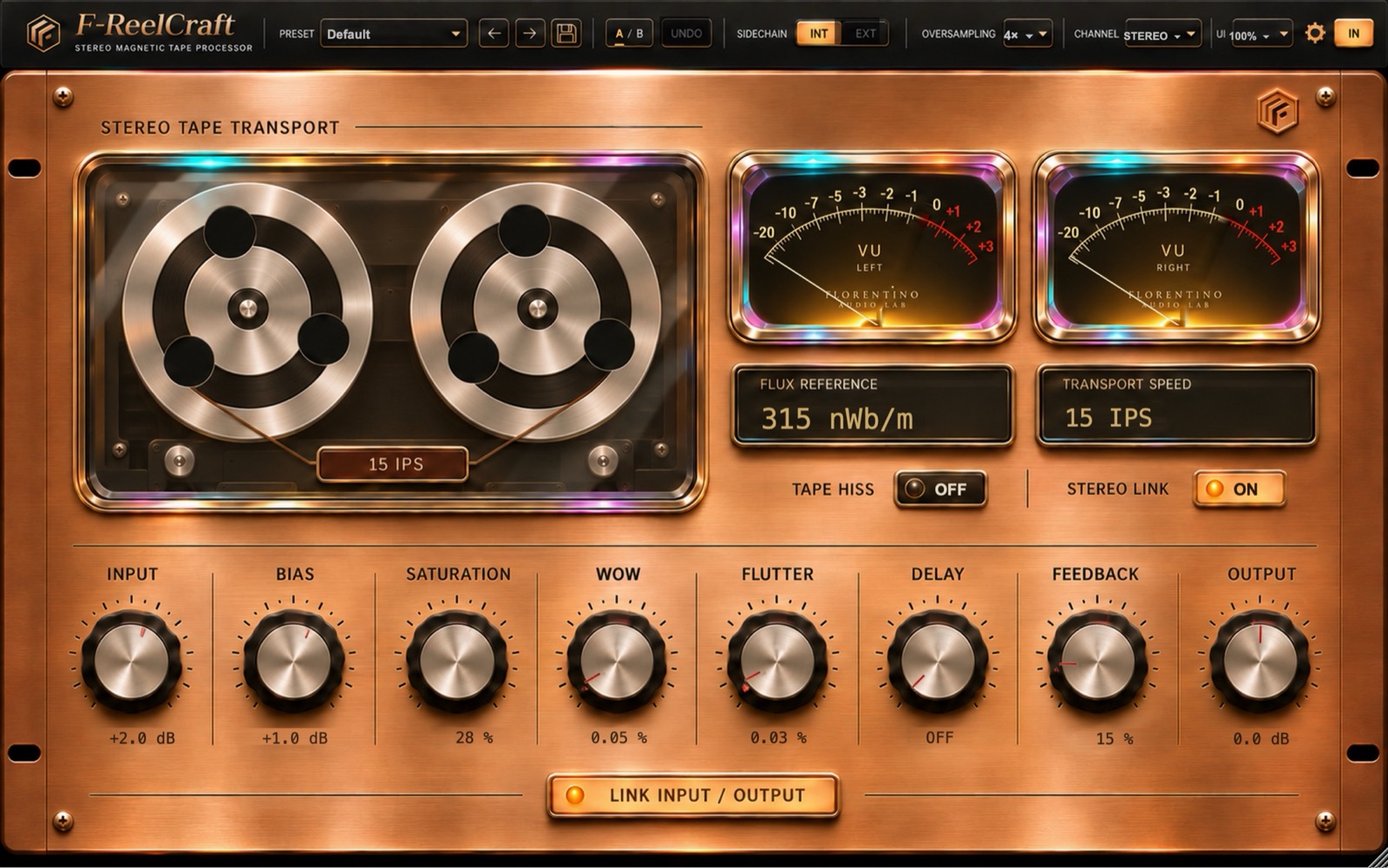
F-ReelCraft is a stereo master tape machine for buses and mixes: the glue, warmth and solid low end of a mix printed to half-inch tape at 15 inches per second, with a stable stereo image.

It shares F-ReelFour's tape engine (record and playback emphasis, an oversampled saturation curve, head bump, high-frequency loss, bias, wow and flutter) with a mastering formulation at 15 IPS, tuned to stay transparent at low drive and to compress gently as you push it.

STEREO LINK makes both channels move together, the way one transport carries both tracks, so the image stays centred; turn it off for a wider, more alive feel. TAPE HISS adds the noise floor of a real machine, only if you want it.

Controls and a sound sample →

BUS & MASTER

F-Loudscope

F-Loudscope

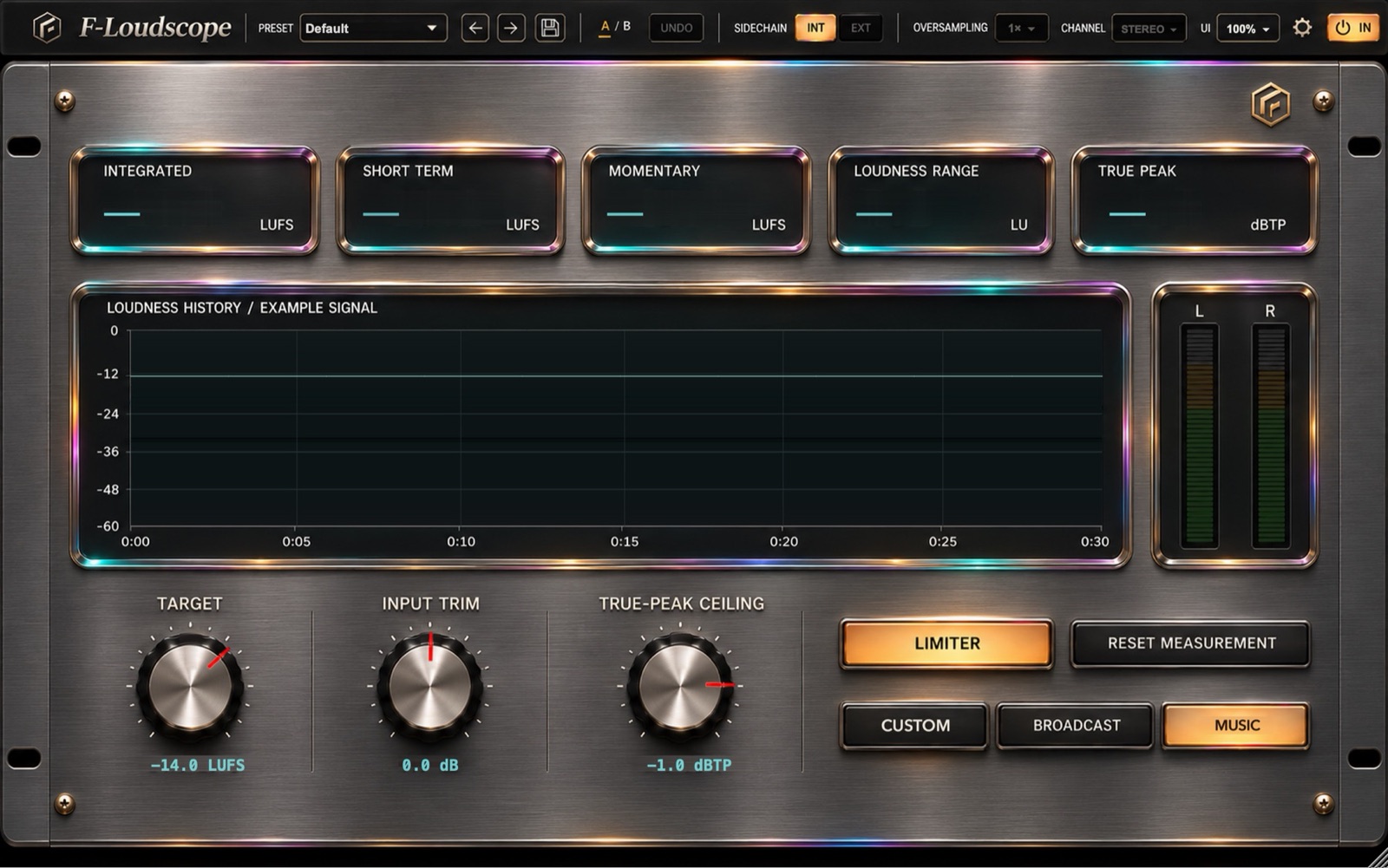
F-Loudscope measures loudness the way streaming services and broadcasters do (LUFS, loudness range and true peak, to ITU-R BS.1770 and EBU R128) and ends your master with a true-peak limiter that never lets the output cross the ceiling you set. Its screen opens on a mastering spectrum, a polar-sample stereo view and a phase-correlation meter; one click on VS shows the loudness history.

Loudness is measured on the output through the standard K-weighting filter: MOMENTARY (400 ms), SHORT TERM (3 s), INTEGRATED (the whole song, with the standard gates) and LOUDNESS RANGE. The meter passes the EBU test cases, and its true-peak reading is accurate to 0.003 dB on any tone up to 20 kHz: it reads the peaks between the samples, the ones that clip a DAC or a codec.

The limiter works only on true peaks: under the ceiling the audio passes untouched, bit for bit. When a peak would cross it, a 1.5 ms look-ahead brings the gain down smoothly before the peak arrives, holds it briefly and lets go with a release that follows the music. Tested on hostile material, the output sits at the ceiling and never above.

Pick MUSIC (−14 LUFS) or BROADCAST (−23 LUFS) and the target and ceiling follow. The screen opens on a high-resolution spectrum (with a 4.5 dB per octave slope, the way mastering engineers read a mix), the polar sample (where every sample sits in the stereo field) and the correlation meter from +1 (mono) to −1 (out of phase); VS swaps it for the loudness history against your target.

Controls and a sound sample →

F-Needle

F-Needle

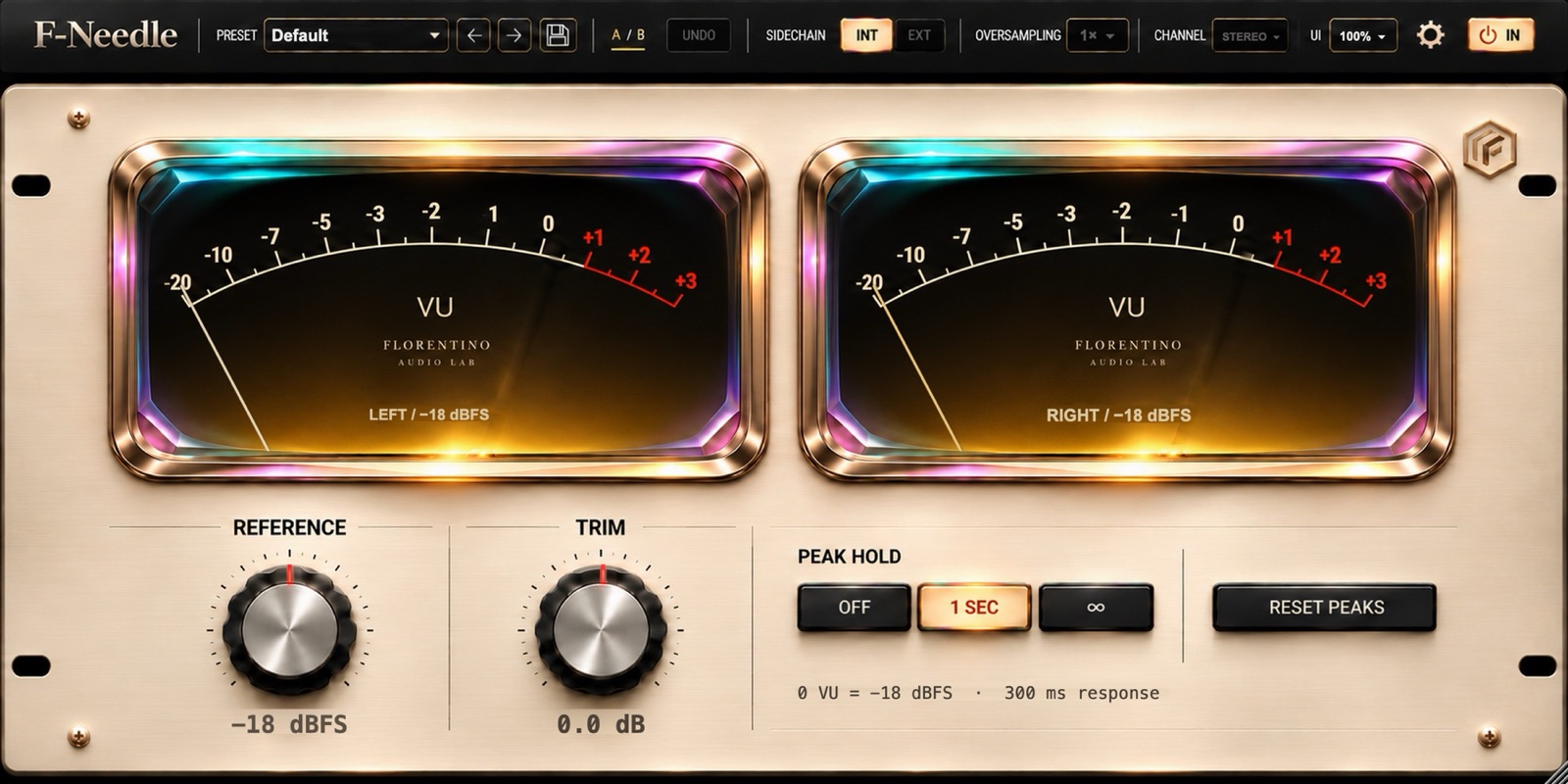
F-Needle is a pair of real VU meters and a perfectly clean gain knob. Set every track to the level analog-style processors like best, and stop guessing why a plug-in sounds too hot or too thin.

Analog-style plug-ins behave like hardware: they have a sweet spot, usually around −18 dBFS on average. F-Needle's needles move like a real VU movement (300 ms to settle, a hint of overshoot), so they show the average loudness your ears hear, not the peaks.

Set REFERENCE to the level your chain wants at 0 VU (−18 dBFS by default) and turn TRIM until the needles dance around zero. TRIM is a plain, double-precision gain with no colour and no latency; at 0 dB the audio passes bit for bit.

Controls and a sound sample →

SPACE

F-AetherSpace

F-AetherSpace

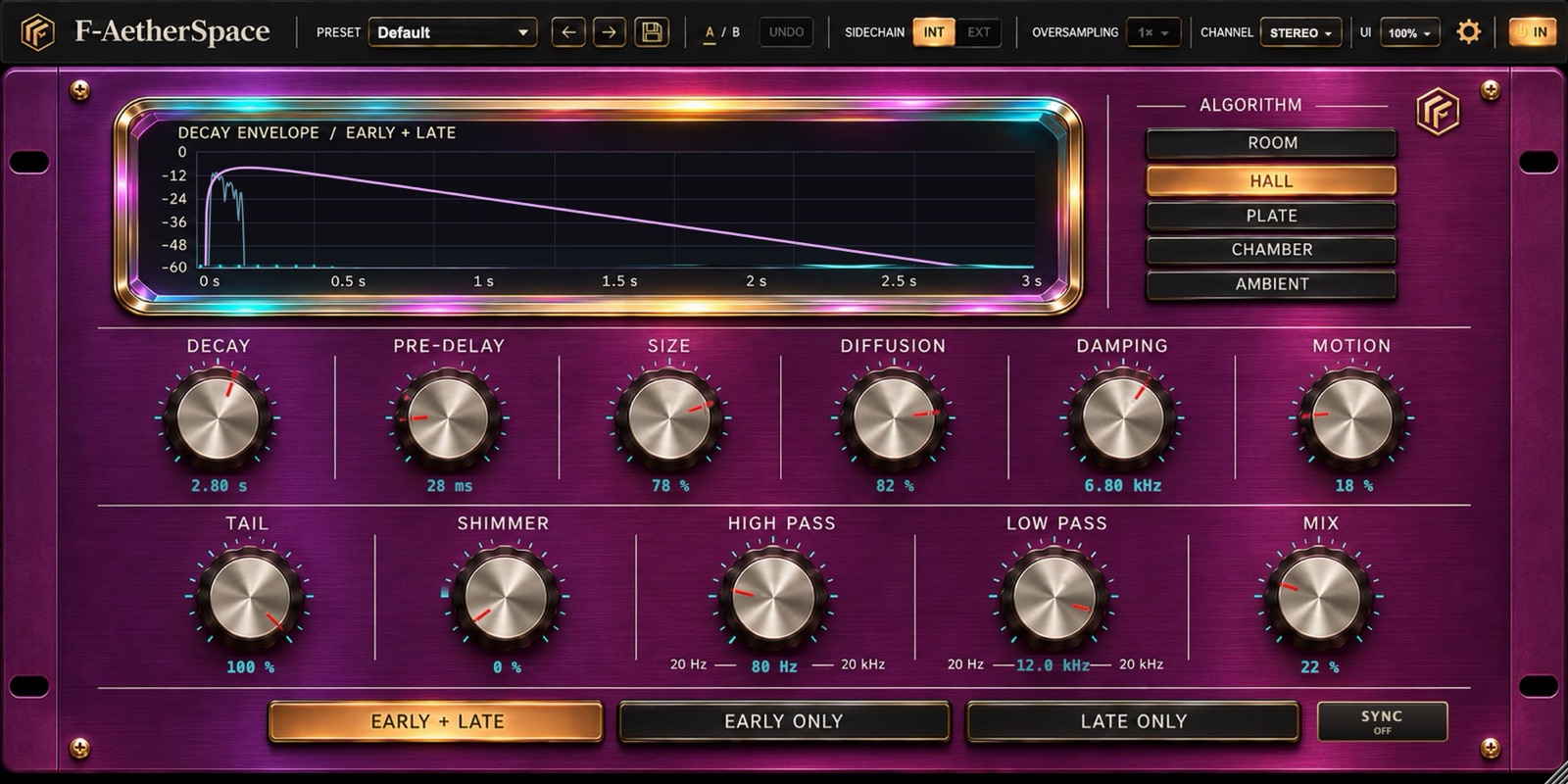
F-AetherSpace is an algorithmic reverb with five spaces, from a tight room to a vast ambient wash. Dense, smooth and free of metallic ringing, with a decay you can lock to your song's tempo.

Behind a pre-delay and four diffusers, an eight-line feedback delay network builds the tail: eight echoes that feed each other through a balanced mixing matrix, each one darkened a little on every pass, so the reverb grows dense quickly and decays naturally. A slow MOTION keeps the tail alive and avoids ringing.

The five ALGORITHMS change the scale of the space, the pattern of the early reflections, the density and the motion. DECAY is the reverb time in the lows and DAMPING shortens the highs, as in a real hall. SHIMMER feeds an octave-up copy of the tail back into it for ethereal pads. SYNC locks the decay to a quarter note up to four bars at your host tempo.

Controls and a sound sample →

F-EchoGrid

F-EchoGrid

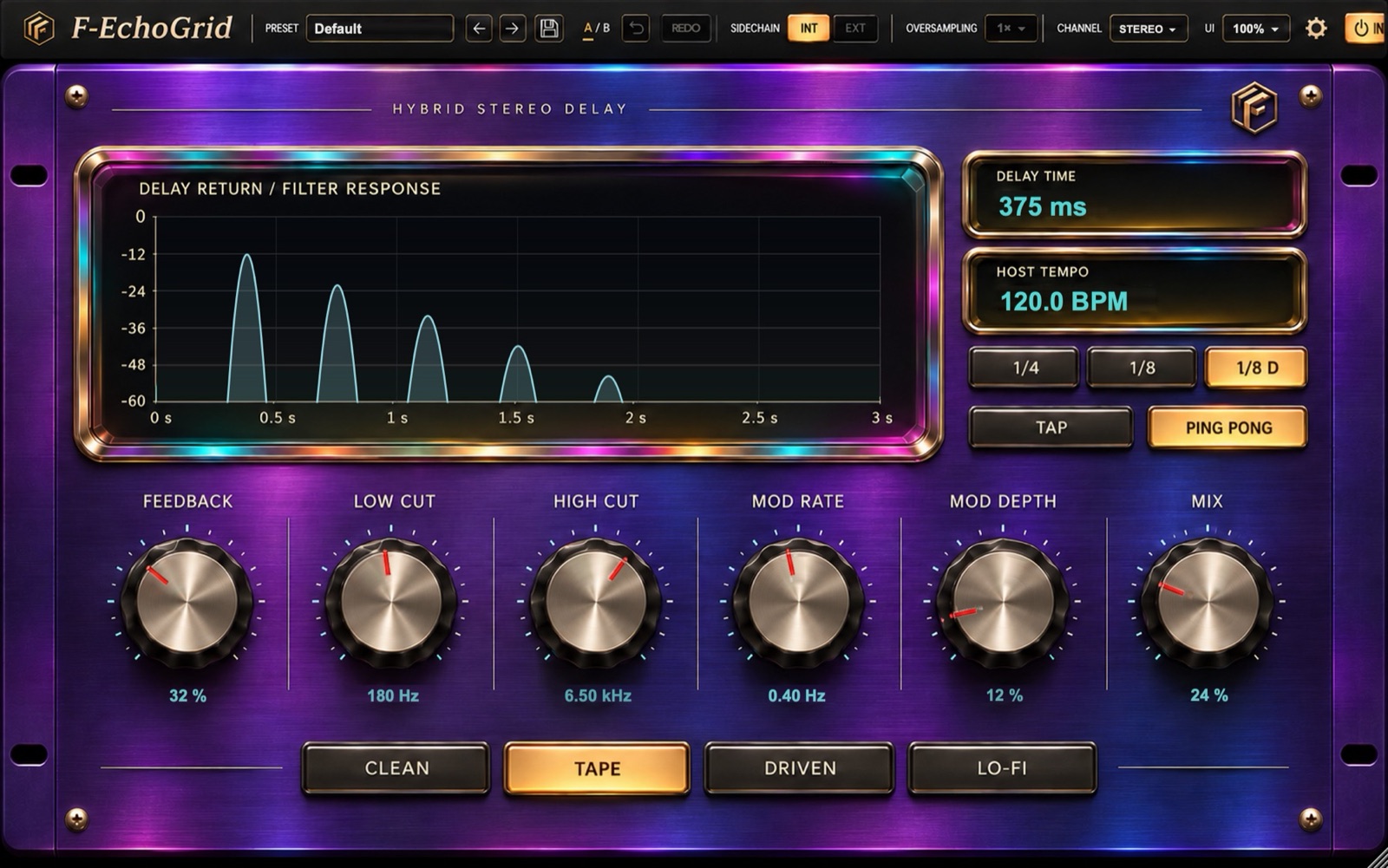
F-EchoGrid is a stereo delay that locks to your tempo, bounces left and right, and ages each repeat the way you choose: clean, tape, driven or lo-fi. From a subtle slap to a dub throw in one window.

Choose a note value (a quarter, an eighth or a dotted eighth at your host tempo) or TAP a free time. Every repeat passes through LOW CUT and HIGH CUT, so the echoes never fight the dry sound. MOD RATE and MOD DEPTH move the read point by up to 2 ms for tape wobble or a lush chorus.

The four CHARACTERS live inside the feedback loop, so they build up with every repeat: CLEAN is exact, TAPE saturates softly, DRIVEN is hot (and anti-aliased), LO-FI drops to 11 kHz and 10 bits for a dark, crunchy echo. PING PONG sends the repeats from one side to the other.

Controls and a sound sample →